RAMUS INSIGHT
The Taycan’s 800-volt architecture changes the home charging equation. Here’s what you actually need.
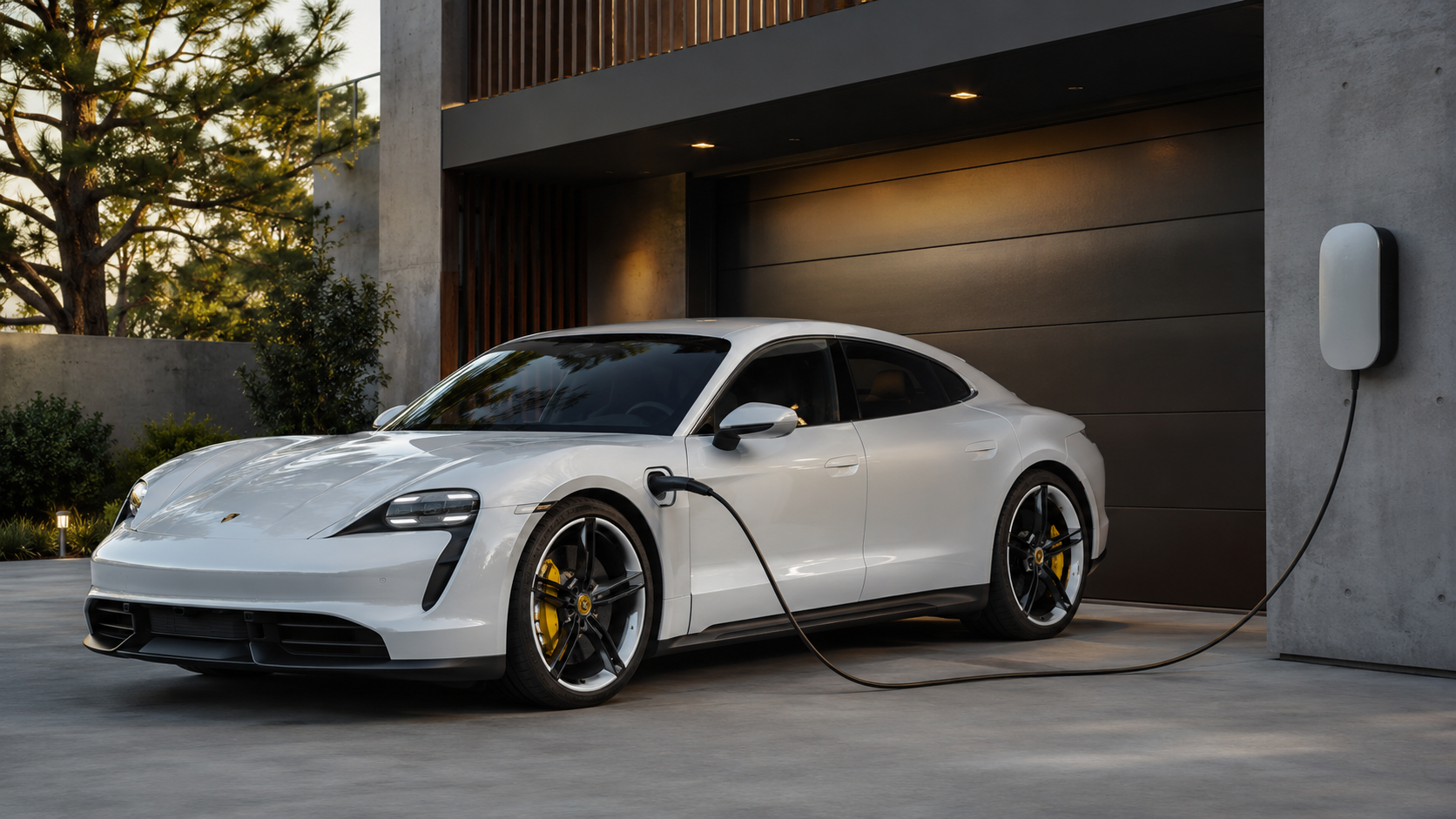
The Taycan is the most technically advanced car Porsche has ever made, and its charging architecture reflects that. For most UK owners, setting up home charging is straightforward — but understanding the options properly means you won’t overspec the install or leave performance on the table. This is what we tell Taycan owners who come to us.
What makes the Taycan different
Most electric vehicles run on a 400-volt electrical architecture. The Taycan runs on 800 volts — double the voltage — which is why it can accept DC rapid charging at up to 270kW on current models, and up to 320kW on the 2025 Taycan. For home charging this high-voltage system doesn’t change the practical equation much, because home wallboxes supply AC power and the car’s onboard charger converts it. But it does mean the Taycan handles charging intelligently and efficiently, and pairs well with smart tariff scheduling.
What wallbox do you actually need?
A 7kW wallbox is the standard recommendation for UK home charging and is the right choice for most Taycan owners. It uses a Type 2 connector, which is what the Taycan accepts for AC charging. On a 7kW charger, a Taycan with the Performance Battery charges fully in around 12 hours; the Performance Battery Plus takes around 13 to 14 hours. In practice, most owners plug in overnight and wake to a full car regardless of the battery spec.
The Taycan supports up to 11kW AC as standard, with an optional 22kW onboard AC charger on some variants. A 7kW home wallbox won’t use that full capacity, but 7kW is the standard single-phase ceiling for UK domestic supplies. If you have three-phase power at home — less common but not unusual in rural properties or converted commercial buildings — you can install an 11kW or 22kW wallbox and take advantage of the Taycan’s full AC charging capability.
Smart chargers and tariff scheduling
This is where Taycan home charging gets genuinely interesting. Octopus Intelligent Go is the EV tariff most Taycan owners gravitate towards — it offers very low off-peak overnight rates, typically available from around 11pm to 5am, which is exactly when you want to be charging. A compatible smart charger communicates with the tariff so charging schedules itself automatically. Popular choices among Taycan owners in the UK include the Zappi (particularly good if you have or are planning solar panels), the Wallbox Pulsar Plus, and the Pod Point Solo. The Ohme charger has had mixed reports with Octopus Intelligent specifically, so it is worth checking current compatibility before committing.
What does it cost to charge at home?
On a standard UK electricity tariff at around 28p per kWh, a full charge from empty costs roughly £20 to £25 depending on battery size. On an off-peak EV tariff at around 7 to 8p per kWh, the same charge costs around £6 to £8. Over a year of regular charging the saving is substantial — typically £500 to £600 compared to a standard rate, and significantly more versus public charging networks.
Public charging for longer trips
The Taycan’s CCS connector gives access to the full range of UK public rapid chargers. On a 150kW or higher charger, the Taycan can add significant range in around 20 minutes. On a 350kW ultra-rapid charger — increasingly available at motorway services — the 800-volt architecture means the Taycan sustains high charging speeds without the power tapering that affects many 400-volt cars. For day-to-day use, most Taycan owners rarely need to use public infrastructure at all. Home charging covers the vast majority of journeys.
Battery care and long-term health
For day-to-day home charging, keeping the battery between 20% and 80% is the approach most EV specialists recommend for long-term cell health. The Taycan allows you to set a charge limit in the car or the Porsche Connect app. Charging to 100% occasionally for long trips is fine — just avoid leaving it at 100% for extended periods. The Taycan’s battery thermal management is sophisticated and largely takes care of itself, but avoiding regular deep discharges and charges to full is a sensible habit.
If you’ve recently taken delivery of a Taycan and want to talk through any aspect of ownership, charging, or servicing, the team at Ramus is happy to help. We service Taycans regularly and understand the car in detail.
